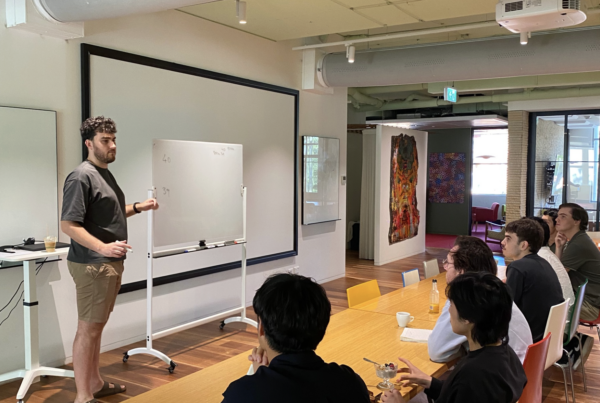
Jason joined VivCourt as a graduate trader after completing our internship program. He’s now eight months in, working in our systematic, medium-frequency trading team. He recently spoke to Cassie Chen from the UNSW Actuarial Society (ASOC) for its Careers Guide. This is an edited version of that conversation, in Jason’s words.
Getting into trading
I came into university not knowing too much about trading. I knew I enjoyed reading the news and had enjoyed economics in high school, so my first year at university involved a lot of exploration. I attended various career fairs, spoke to people and eventually came across the quantitative trading industry. Back then, around five years ago, it wasn’t as prominent on campus.
I interned at a smaller trading firm during my earlier years at university and really enjoyed the experience. I wanted to experience trading at a larger-scale firm, so I prepared for interviews and applied to VivCourt. I was fortunate enough to receive an internship position and then a return offer.
In terms of what I studied, I initially started with finance and mathematics. I quickly realised that I could probably learn a lot of the finance side independently, so I eventually graduated with a computer science and mathematics degree, which has been very beneficial in what I do day-to-day.
What my day actually looks like
Broadly, you can separate trading roles into research-oriented roles. I sit more on the research side. My day usually starts with checking the news and seeing what’s moved in the markets. My team trades products that trade continuously, so there aren’t really fixed market hours for us; it’s effectively 24 hours. We have people monitoring things during the night session, so we’ll take over from them and look into any issues that have arisen – occasionally there will be something we need to investigate.
Once that’s out of the way, I’ll prepare what I’m going to work through for the day, grab breakfast, which our Human Experience team kindly prepares for us every morning, and then get into research and team meetings. The research is quite self-motivated. If I find something interesting that I think could have value, I’ll investigate it. That could involve new alpha research, finding new things that we think might be predictive of markets, or working on areas such as execution and portfolio management.
We also have a peer-review process where people present their research, and everyone on the team contributes their opinions and feedback about what they should focus on. In terms of what I physically do, it’s mostly coding, working through mathematics on paper, and working within development and production environments through the command line.
What kind of problems do you work on?
At a high level, the problems you come across are really interesting and largely unsolved. You could have a portfolio optimisation question where you have an ideal portfolio that you want to track, and the question becomes: how do you actually trade towards that?
It’s very open-ended, and you can’t necessarily find a solution even after going through a lot of academic papers. It’s quite exciting, especially in the age we’re currently living in. AI is incredibly helpful for bouncing ideas around, browsing large numbers of papers quickly and identifying insights that might be valuable to what you’re currently working on.
I’m also fortunate that my team is filled with really smart people, including a lot of people with PhDs, so I can lean on them when thinking about which areas I should investigate or how I should approach a particular problem.
More collaborative than you’d expect
I think a lot of students still picture trading as making fast, instinctive calls on what to buy and sell. That’s very much not the case. Regardless of what trading style you’re working in, you rely heavily on different parts of the business. For example, we spend a lot of time working with developers, understanding their requirements and what they can see from their perspective, while also communicating what we need. There’s also a lot of collaboration among researchers. When you’re doing research, it’s very easy to become pigeonholed and converge on one particular way of looking at something.
I’m a recent graduate, and I’ve only been at VivCourt for around eight months, so the people around me have much more experience. One thing I’ve noticed about VivCourt is that everyone is very invested in your personal growth. People are willing to stop what they’re doing and help you out. It benefits you personally, but it also benefits the team when another person understands a particular part of the trading system or knows how to approach research. That’s been really beneficial for my development, and as I develop, the team is able to move faster, iterate faster, assign more responsibility and ultimately get more work done.
Why VivCourt
I think there are two aspects to what attracted me here: VivCourt’s overall culture and the culture of my particular desk.
VivCourt’s culture really stands out compared with other trading firms. What makes us unique is the charitable aspect of the organisation. We don’t have traditional shareholders whose interests we’re beholden to, and philanthropy is an important part of the firm’s mission. Our founder Rob’s philosophy has always been that if you make money, it shouldn’t only be you who benefits; the broader society should benefit as well. I’ve been able to direct funding towards my local high school, and I’ve seen other people support charities around the world. We’ve received a lot of positive messages from recipients explaining the impact the funding has had.
In terms of my particular team, I felt that its style was well suited to the way I like to work. I’m someone who likes to spend a while thinking about a problem, rather than always making very quick decisions. I also saw how invested the team was in AI. I’m quite bullish on AI, so the combination of research and really pushing the boundaries of how AI can be used within our quantitative processes was appealing to me.
If you’re thinking about applying
Firstly, understand your motivations for wanting to go into trading. A couple of years ago, you might have been able to say that trading simply seemed interesting, but now there are so many applicants. It’s difficult to stand out if you don’t have a strong reason for why you want to pursue quantitative trading. Part of understanding whether it’s right for you is speaking to people at the firm. I don’t think people who are interested in quant place enough emphasis on this part of recruitment. I spoke to a couple of traders who were working at VivCourt, so I developed a strong understanding of VivCourt’s trading style and its values.
Secondly, work on projects. It’s incredibly easy nowadays to make projects using tools such as Claude Code, Codex or other LLMs, but avoid producing something generic that you can’t genuinely explain yourself. You can use AI to help explain concepts, but you should be able to explain the entire project from start to finish: your motivation, how you approached it, the assumptions you made, the challenges you encountered and what you learned. If anything, avoid simply making another generic Black-Scholes options project.
I also spent quite a bit of time preparing for the behavioural interview. A lot of students focus almost entirely on preparing for the quantitative or technical aspect of the interview. That’s important, but at VivCourt we also place a significant emphasis on the behavioural side. I was fortunate enough to have a mentor, but if I were doing it again, I’d say the more mentors, the better- people who are invested in your growth and want you to do well. AI can do an okay job of helping, but I don’t think it can replace an actual person who has been through those interviews and understands the experience and the stress involved.
Lastly, don’t be discouraged if quant trading turns out not to be for you or you realise you don’t enjoy it. If you pigeonhole yourself and decide that quantitative trading is the only career you want, the world can start to seem quite narrow. In reality, there are more opportunities than ever. If I hadn’t gone into quantitative trading, I think I would have enjoyed working at a startup. They’re also competitive, fast-paced, fast-moving and incredibly entrepreneurial. Trading actually has some similar characteristics. That’s partly why I arrived at trading in the first place. If you have your own strategy, it’s almost like running your own startup.
Thanks to Cassie Chen and the UNSW Actuarial Society for the interview.
Curious about careers at VivCourt? Sign up for updates on relevant roles, events and opportunities.