
The first article covered what an option is and why volatility matters to its price. The complication is that an option exposes you to several things at once – direction, movement, time and changing implied volatility. A volatility-focused position therefore needs to separate the intended exposure from the others. Delta, gamma, theta and vega are the main measures used to do that.
Delta: your exposure to the underlying
Delta measures how much an option’s value changes when the underlying moves. A call with a delta of 0.50 should gain roughly 50 cents if the share price rises by $1, assuming the other inputs stay the same.
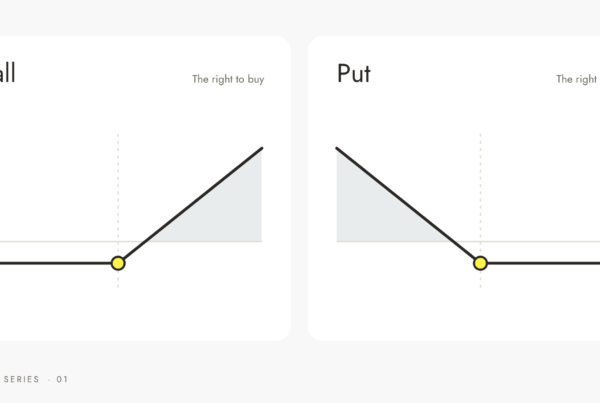
For a call, as the share price moves further above the strike, delta approaches 1 and the option behaves more like the underlying. Well below the strike, delta approaches 0 and small movements have less effect on the option’s value. Calls therefore have deltas between 0 and 1, while puts run from 0 to −1.
Delta also acts as a hedge ratio. If you own calls over 1,000 shares with a delta of 0.50, the position has roughly the same immediate directional exposure as owning 500 shares. Shorting 500 shares would make it approximately delta-neutral, meaning its net delta is close to zero. If the view is on volatility rather than direction, this reduces the immediate impact of the underlying simply rising or falling.
Delta can also give a rough sense of the probability that an option will finish with intrinsic value. Options are often referred to by the absolute value of their delta: for instance, a put with delta -0.25 is a 25-delta put and it would be loosely associated with a 25% chance of finishing below the strike, although delta is not itself a probability measure.
Gamma: how quickly delta changes
Delta does not stay fixed. As the underlying moves, delta changes too, which means a hedge that was accurate earlier may no longer be.
Gamma measures how quickly delta changes as the underlying moves. If a call has a delta of 0.50 and gamma of 0.08, a $1 rise in the share price would increase delta to roughly 0.58; a $1 fall would reduce it to roughly 0.42.
Gamma tends to be highest when the underlying is near the strike and close to expiry, where small moves can cause delta to change quickly. When the underlying is further from the strike, delta is closer to one of its extremes and changes less, so gamma is lower.
Suppose you own a call over 100 shares with a delta of 0.50 and short 50 shares to delta hedge it. If delta rises to 0.58, the option now has exposure equivalent to about 58 shares, so another eight shares would need to be sold to return the position to neutral.
A long call or put generally has positive gamma. Re-hedging a long-gamma position therefore tends to involve selling shares after rises and buying after falls. Repeating this process is known as gamma scalping. A short-gamma position works in reverse.
If the underlying moves enough, those hedge adjustments can generate gains. But owning options also comes with time decay, so the movement has to compensate for that cost.
Theta: the cost of waiting
The ability to benefit from future movement has a cost. Theta measures how an option’s value changes as time passes. For a long option, theta is usually negative and commonly expressed as the amount of value lost each day, assuming everything else stays the same.
An option with theta of −0.04, for example, would lose roughly four cents over one day if the underlying price, volatility and other inputs did not change.
As Article 1 explained, part of an option’s premium is time value. As expiry approaches, there is less time for the underlying to move, so that value decays – usually fastest for options near the strike.
Gamma and theta are closely linked. Options with high gamma also tend to have high time decay, particularly when the underlying is near the strike and close to expiry. Greater exposure to short-term movement therefore comes at a higher cost of waiting.
- A long call or put is long gamma and pays theta.
- A short call or put is short gamma and collects theta.
For a delta-hedged position, the key question becomes: did the underlying move enough to compensate for the time decay?
Suppose an option is bought at 22% implied volatility and its delta is hedged. If the underlying later moves at closer to 28% realised volatility, gains from movement and re-hedging may outweigh theta. If it realises closer to 16%, time decay may dominate instead.
Where the movement happens also matters. Because gamma is highest when the underlying is near the strike, the same move can have a greater effect while the option is near the money than after the underlying has moved well away from it.
Other factors such as changes in implied volatility and transaction costs also affect P&L, but the central trade-off is simple: gamma provides exposure to movement; theta is the cost of waiting for that movement.
Vega: sensitivity to implied volatility
Gamma is about the underlying actually moving. Vega measures the effect of implied volatility changing. It is typically quoted as the change in an option’s value for a one percentage point – or one vol point – move in implied volatility.
Suppose an options book has $5,000 of vega per vol point. If implied volatility rises from 22% to 28%, a six-point increase:
Vega P&L ≈ $5,000 × 6 = $30,000
The underlying does not need to move for this to happen. A long-vega position becomes more valuable because the market is pricing a wider range of future outcomes. A six-point fall in implied volatility would have the opposite effect, assuming everything else stayed the same.
This creates an important distinction between expiries: short-dated, near-the-money options tend to have more concentrated gamma, while longer-dated options generally carry more vega.
The volatility surface
The Greeks describe the risks of an individual option or portfolio. The volatility surface provides the broader pricing context. Every option price can be translated into an implied volatility. Mapping those implied volatilities across strikes and expiries produces the volatility surface.
Two patterns matter:
- Skew: how implied volatility differs across strike prices. In equities, lower-strike options often trade at higher implied volatility, partly reflecting demand for downside protection.
- Term structure: how implied volatility differs across expiries. An upcoming event, for example, can make options covering that period more expensive than earlier expiries.
The surface can reveal relative-value opportunities. A strike or expiry may look unusually cheap or expensive compared with those around it – although differences often have a valid explanation.
Putting it together
The Greeks tell you what an option position is exposed to:
- Delta: direction – how the option responds when the underlying moves.
- Gamma: how delta changes.
- Theta: the effect of time passing.
- Vega: the effect of changing implied volatility.
If the view is on volatility rather than direction, the delta of an option can be hedged using the underlying. After delta hedging, the position then depends more on how much the underlying moves, the time decay paid or collected, and changes in implied volatility. Gamma also changes delta as the market moves, so the hedge needs to be adjusted.
The volatility surface adds the comparison: how is this option priced relative to other strikes and expiries?
Together, these tools help answer whether an option is priced attractively relative to the alternatives, and what risks come with the position.
The final article looks at how those ideas are applied across different strategies.
Curious about careers at VivCourt? Sign up for updates on relevant roles, events and opportunities.