An option gives you the right to buy or sell something at a set price, by a set date. What makes options interesting is working out what that right should cost. This is the first of three articles on how options trading works, developed with one of our experienced options traders, Dom S.
What is an option?
An option is the right, but not the obligation, to buy or sell something at a set price, by a set date.
What does right, but not the obligation actually mean? Imagine a house is on the market for $800,000. You’re interested but not ready to commit, so you pay the owner $10,000 for the right to buy it for $800,000 at any point over the next six months.
Six months later:
- The house is worth $900,000. You use the agreement, buy it for $800,000 and gain $100,000 in value, minus the $10,000 you paid.
- The house is worth $700,000. You walk away. You lose the $10,000, but you’re not forced to buy the house for $800,000.
That is the basic structure of an option: you pay a fixed amount upfront for the right to make a decision later. Listed options work similarly, except the strikes and expiry dates are standardised by an exchange and the premium (the $10,000 you paid) is determined by buyers and sellers, with market makers quoting prices on both sides. Options can be written on shares, indices, exchange-traded funds, commodities, currencies, interest rates and cryptocurrency. Whatever the option is written on is called the underlying.
The six words you need to understand
Four come directly from the house example:
- The premium is what the option costs – the $10,000.
- The strike price is the fixed price in the agreement – $800,000.
- The expiry is the deadline – six months.
- To exercise an option means using the right written into the contract.
The other two describe the main types of option:
- A call gives you the right to buy at the strike price. It becomes more valuable as the underlying rises.
- A put gives you the right to sell at the strike price. It becomes more valuable as the underlying falls.
In options terminology, the buyer is long the option. The seller, or writer, is short it.
How you make and lose money
If you buy an option, the most you can lose is the premium. If the move you’re hoping for does not happen – or is not large enough – the option can expire worthless. If you sell an option, you collect the premium but take on the obligation on the other side, which can create much larger losses if the market moves sharply against you. Options exist for the same reason insurance does: someone wants to offload a risk, and someone else will take it on for a price.
At VivCourt, we trade options through market making and positional strategies. Market making looks for small pricing edges repeated across many trades, while positional strategies can look for larger opportunities in volatility, relative value or specific events. The approaches differ, and we’ll unpack each later. For now, the key point is that all of them depend on judging what an option should be worth relative to the risk it carries.
So what determines an option’s price?
At a basic level, an option’s value depends on a few key inputs:

Pricing models combine these inputs to estimate a theoretical value; the actual premium is determined in the market. Volatility is the most judgement-heavy input because future price movement can’t be observed in advance. Whereas spot, strike and time to expiry are known and expected dividends can usually be estimated.
What makes up the premium?
An option’s premium has two parts: intrinsic value and time value.
Using the house analogy, say the house is worth $805,000 on the day you pay $10,000 for the right to buy it at $800,000. $5,000 of that premium is intrinsic value, because you could buy the house for $5,000 less than it’s worth. The other $5,000 is time value: what you’re paying for the chance the house rises further before expiry.
If the house later rises to $850,000, the option now has $50,000 of intrinsic value, plus some time value if there’s still time before expiry for the house to keep rising.
What volatility actually measures
Volatility measures the annualised standard deviation of returns or, more simply, how spread out an underlying’s price moves are. It describes how much prices move, not whether they move up or down.
Volatility is usually quoted annually. Variance scales linearly with time, so with about 252 trading days in a year, daily volatility is annual volatility divided by √252 ≈ 16 (assuming independence of daily returns):
- 15% annual volatility ≈ 0.9% daily volatility
- 55% annual volatility ≈ 3.5% daily volatility
All else equal, higher volatility makes options more valuable because it widens the range of possible outcomes before expiry and increases uncertainty.
For a call, for example, greater volatility creates more potential upside outcomes, while the payoff cannot fall below zero. That asymmetric payoff makes the option more valuable, but the buyer pays for that extra opportunity through a higher premium.
Two kinds of volatility
It’s important to distinguish between implied and realised volatility.
Implied volatility is the level of future movement reflected in an option’s current price. For example, if a one-year call on a $100 share costs $12 and the other inputs are known, a pricing model may indicate that 30% volatility produces that price. The option is then said to be trading at 30% implied volatility.
Realised volatility is what happens afterwards – how much the underlying actually moves over that period. So if the option was trading at 30% implied volatility but the underlying later realised only 20%, the market had priced in more movement than actually occurred.
Implied volatility is therefore best thought of as the market consensus price of volatility, rather than a guaranteed forecast of what will actually happen.
Both are quoted in the same unit. One percentage point of annualised volatility is called a vol point, so a move from 22% to 28% implied volatility is described as being “up six vol points.”
Options can be sold when implied volatility looks high relative to the volatility expected to be realised, and bought when it looks low. Hedging some of the directional exposure then leaves the position driven more by how much the underlying moves rather than by which way it goes.
Where this goes next
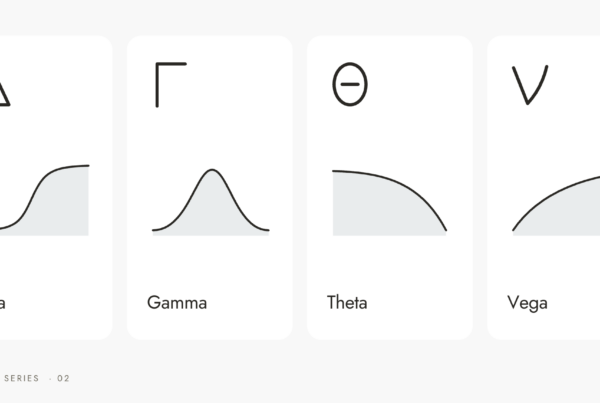
An option’s price depends on a handful of inputs, but future volatility is the key unknown. The complication is that an option also carries exposure to direction, time and changes in implied volatility. The next article looks at how those exposures are measured and managed using risk metrics called delta, gamma, theta and vega.
Curious about careers at VivCourt? Sign up for updates on relevant roles, events and opportunities.