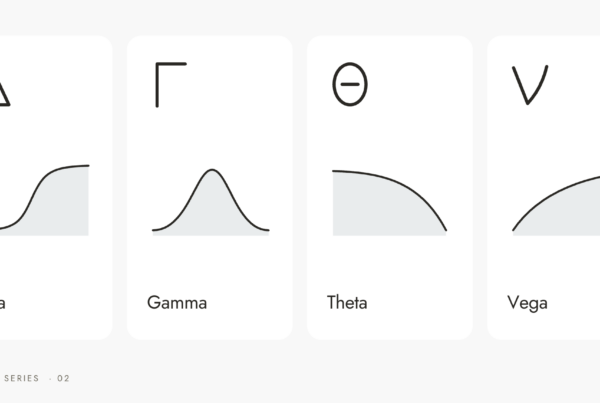
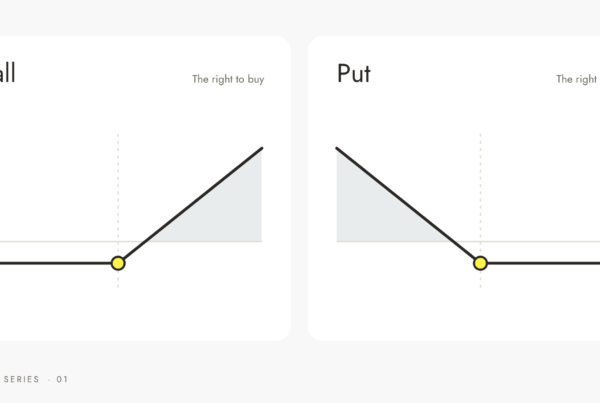
The first article covered what an option is and why volatility matters to its price. The second introduced the Greeks and the volatility surface – the tools used to understand risk and compare options. This final article looks at how those ideas are applied across different trading strategies.
Where the opportunities come from
Different market participants use options for different reasons: to protect a portfolio, generate income, take a view on volatility or position around an event. A fund might buy puts to protect a large holding it does not want to sell. An investor might sell calls against shares they already own, earning premium in exchange for capping some of the upside. Our options desk operates in the same market, providing liquidity to some of that activity and taking positions of its own. Here’s what that looks like in practice.
Market making
Market making means continuously showing a bid to buy and an offer to sell across many strikes and expiries, while meeting exchange quoting obligations across specified option series.
Fair values are generated using the volatility surface alongside inputs such as the underlying price, rates, dividends and time to expiry. Every trade changes the risk of the overall book. Delta is typically managed using the underlying shares or futures, while gamma, vega and other exposures are monitored across the portfolio. Quotes can also be adjusted as inventory changes.
The edge on each trade may be small, so three things matter in particular:
- Pricing: estimating fair value accurately enough to quote competitively without consistently trading at the wrong price.
- Execution (or latency): updating quotes and hedges quickly as the market moves.
- Risk management: understanding the combined exposure across the entire book, not just each option individually.
Event trading
Event trading means taking positions ahead of a specific catalyst, such as earnings, economic data or a policy decision, and often holding them for days or weeks.
Earnings are the clearest example. The announcement date is known, but the result and market reaction are not, so options expiring after it typically include an event premium for the possibility of a larger-than-usual move. Once the result is out, that uncertainty disappears and implied volatility can fall sharply.
So getting the direction right isn’t enough. If the share price rises by less than the market expected, a call bought before earnings can still lose value.
The US CPI print is another example. The release time is known but there is uncertainty around how the print affects future interest rates. Because rate changes can have large effects on equity markets, CPI day often brings a spike in volatility.
For any event like this, the question is: how far could affected markets move, and are options covering that period pricing enough uncertainty? One approach is to map plausible scenarios, assign a probability to each, and compare the resulting distribution with the move already priced in.
How much evidence is available changes the analysis considerably. Like earnings, CPI has a long history of previous releases to compare against. A one-off geopolitical or policy event has far less comparable data, so scenario analysis, event-specific research and judgement matter more.
Timing and position sizing are key considerations. A scheduled event like earnings or CPI affects specific expiries, while an event that could happen any time over several weeks may affect many. Event risk also includes tail outcomes, so positions should be sized for more than the most likely scenario, and for the combined exposure if several are held at once.
Key Takeaways
Across the three articles:
- Options price uncertainty, largely through implied volatility. Buyers pay a premium for an asymmetric payoff: potential upside, with losses capped at the premium.
- The Greeks and the volatility surface help traders understand a position’s risks and compare options across strikes and expiries.
- Market making looks for edge through pricing and execution; event trading looks for differences between expected outcomes and what options are pricing.
- Pricing and risk management are inseparable: a position still has to be sized, hedged and managed after the trade is made.
Ultimately, options trading asks more than whether a price will rise or fall; it asks how much it might move, how confident you are in that estimate, and whether the market is charging a sensible price for the uncertainty. There is rarely a definitive answer, so models, market prices and judgement are constantly tested against one another.
Curious about careers at VivCourt? Sign up for updates on relevant roles, events and opportunities.